Agentic AI Is Redesigning the Future of Procurement
Agentic AI represents a major shift in how enterprise work is designed, governed, and executed. Unlike traditional automation or generative AI tools that primarily assist human users, agentic AI introduces software agents that can pursue goals, coordinate across systems, make decisions within defined guardrails, and execute work across complex business processes.
Procurement is one of the clearest enterprise functions where this shift becomes real. It sits at the intersection of spend, suppliers, contracts, risk, finance, legal, supply chain, ESG, and business stakeholders. That makes procurement a natural proving ground for AI-native operating models.
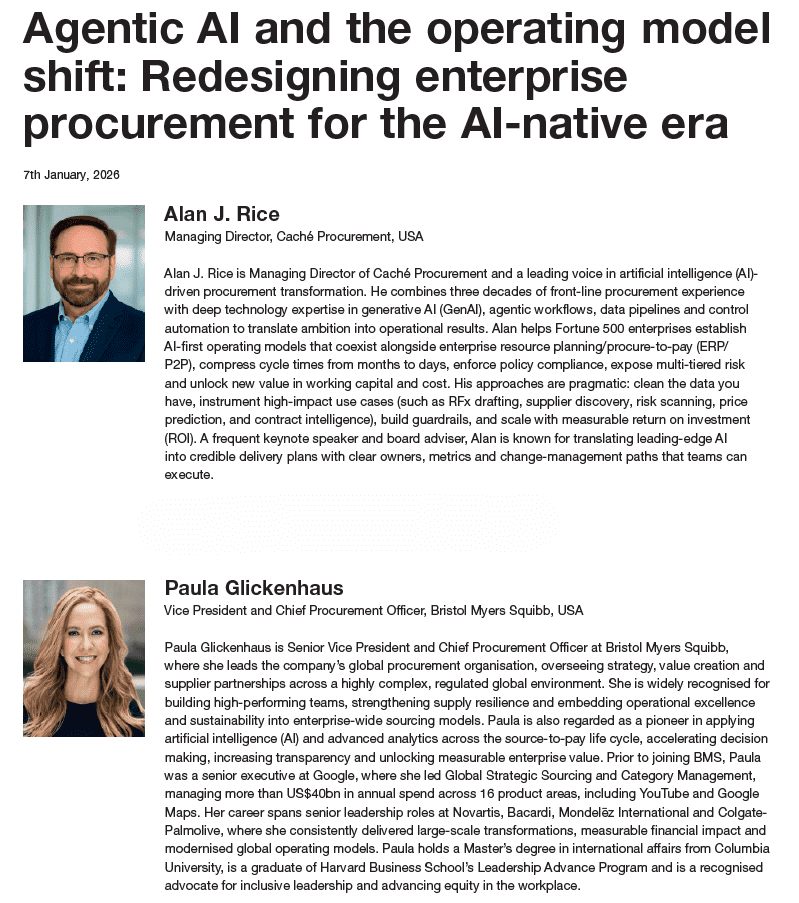
This article, co-authored by Alan J. Rice, Founder & Managing Director of Caché Procurement, and Paula Glickenhaus, Vice President and Chief Procurement Officer, Bristol Myers Squibb, examines how agentic AI can reshape procurement through autonomous sourcing, AI-led negotiation, supplier onboarding, contract intelligence, compliance monitoring, and always-on procurement operations. It also explores the deeper operating model implications, including decision rights, governance, data foundations, human-in-the-loop controls, role design, and the evolving partnership between the CPO and CIO.
The central message is straightforward: agentic AI is not simply another procurement technology upgrade. It requires a new operating model, one built around executable policy, trusted data, clear controls, cross-functional governance, and practical human-AI collaboration.
Article Abstract
Agentic AI is more than a new wave of automation. It represents a fundamental shift in how work is designed, governed, and executed. Unlike earlier machine learning and generative AI tools that mainly produced recommendations or content, agentic AI enables software agents to understand context, make decisions, act across systems, and learn over time.
Procurement is a strong proving ground for this shift because it sits across finance, supply chain, legal, risk, ESG, and business stakeholders while managing complex, high-value decisions. This article argues that agentic AI will reshape procurement from function-centric workflows into an AI-native hub that coordinates autonomous agents, human experts, and connected data.
It explains how agentic capabilities such as autonomous sourcing, negotiation, onboarding, and compliance monitoring will change procurement processes, roles, governance, and decision rights. It also presents a practical blueprint for AI-native procurement, including policy systems, risk management, human-AI collaboration, and an implementation roadmap for CIOs and CPOs. The goal is to help organizations capture the value of agentic AI while maintaining control, resilience, and trust.
Request the full article
To request a copy of the full article, Agentic AI and the Operating Model Shift: Redesigning Enterprise Procurement for the AI-Native Era, please contact Alan J. Rice at alan.rice@cacheprocure.com.
For organizations exploring how agentic AI can improve procurement performance, reduce cycle times, strengthen controls, and redesign the operating model for the AI-native era, Caché Procurement can help translate the strategy into a practical roadmap.