
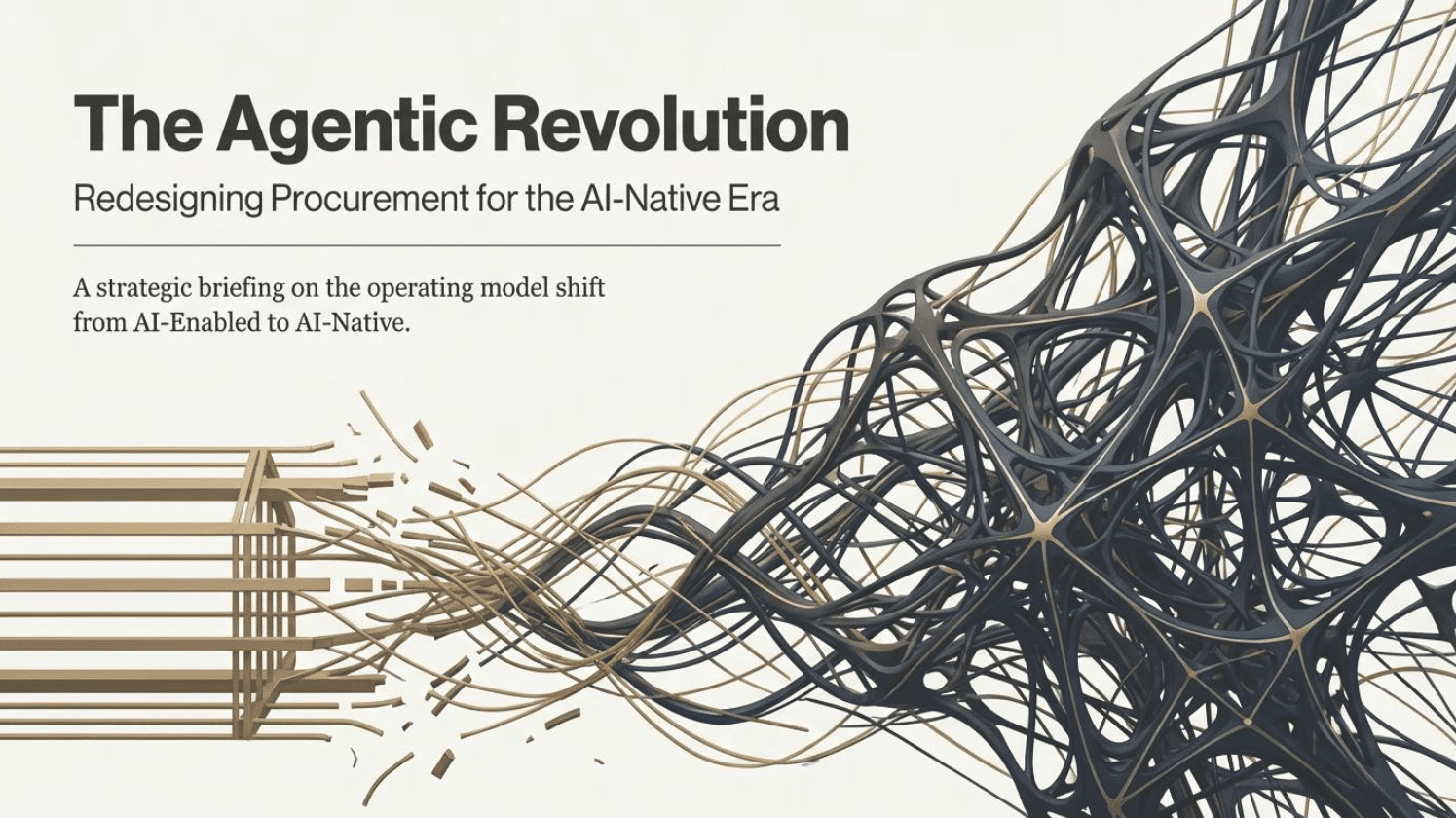
The Agentic Revolution: Procurement’s Opportunity to Lead the AI-Native Enterprise
Most procurement leaders are still asking the wrong question about AI.
They ask which tool to deploy next. The workflow to automate? Which dashboard to improve? The pilot that might save time in sourcing, intake, or supplier management?
Those are fair questions. They are just no longer the most important ones.
The real question is this:
What happens when AI stops acting only as an assistant and starts operating as an agent?
That is the shift now taking shape in procurement. It is a move away from AI as a support layer inside existing processes and toward agentic AI as a driver of a new operating model. In that world, intelligent agents do not just recommend actions. They can plan, coordinate, and execute work across a process, within defined guardrails. Humans do not disappear, but their role changes materially. They move from managing every step to setting direction, defining policy, handling exceptions, and governing outcomes.
This is why the next chapter of AI in procurement is not about technology adoption alone. It is about operating model redesign. AI-native procurement is fundamentally different from AI-enabled procurement. One improves the legacy model. The other replaces it with a new logic for how work gets done.
That distinction matters more than many organizations realize.
In an AI-enabled environment, people still remain tightly involved in each phase of the process. AI helps with analysis, recommendations, classification, summaries, and decision support. It can make people faster, but the workflow still depends on humans to keep it moving.
In an AI-native environment, agents take on a much larger share of execution. They can interpret intent, check policy, match suppliers, initiate workflows, monitor risks, and negotiate within approved thresholds. Humans operate above the loop rather than inside every step of it. That is a very different model of work.
It is also where the economics start to become compelling.
According to The Hackett Group, 64 percent of procurement leaders believe GenAI will fundamentally change how their teams operate within five years. At the same time, procurement workload is projected to rise far faster than headcount. The implication is pretty blunt. Traditional ways of absorbing complexity are breaking down. Productivity cannot depend only on asking teams to work harder or even faster. It has to come from redesigning how work is orchestrated in the first place.
Procurement is uniquely positioned to lead this shift.
That point deserves more attention than it usually gets.
Procurement sits at the intersection of internal demand and external supply by working across finance, legal, business units, suppliers, and risk functions. They manage transactions that range from low-risk tail spend to high-value strategic agreements. Procurement already relies on structured rules, approval matrices, supplier standards, and policy controls. In other words, it already contains the ingredients needed for scaled autonomy. Procurement is not an edge case for agentic AI. It is one of the best places in the enterprise to prove it out. Procurement is the natural epicenter for the AI-native enterprise.
Look at intake as one example.
In many organizations, the intake experience still reflects a manual world. Users fill out forms, route requests, answer follow-up questions, and often struggle to navigate the right buying channel. It is slow, frustrating, and too easy to bypass.
Now imagine a different model.
A user states a need in plain language. An agent interprets the request, applies policy, checks budgets, identifies relevant suppliers, routes approvals, and launches a compliant sourcing process. That is not just process automation. That is intelligent orchestration. The operating model shifts from pushing people through process steps to enabling guided execution through policy-aware agents.
The same logic applies to negotiation, especially in areas like tail spend, where value is often trapped by manual economics.
Historically, procurement has struggled to scale negotiation coverage across thousands of smaller suppliers. The transaction volume is high. The spend per event is often low. Human effort does not scale efficiently.
Agentic negotiation changes that equation.
With clear guardrails around pricing, payment terms, or escalation thresholds, negotiation agents can handle large volumes of supplier interactions simultaneously. In one flagship case involving Pactum and Walmart, an AI agent negotiated with more than 2,000 long-tail suppliers, reduced cycle times from weeks to minutes, and extended payment terms. That is a glimpse of what happens when procurement moves from selective intervention to scalable value orchestration.
Risk management may be even more important.
Most supplier risk programs are still built around periodic reviews, onboarding checkpoints, and fragmented monitoring. That model is increasingly out of sync with the world in which procurement actually operates. Financial stress, compliance issues, geopolitical shocks, and ESG pressures do not wait for quarterly reviews.
An AI-native approach enables agents to monitor supplier risk continuously. They can run know-your-supplier checks, track external risk signals, monitor changes in financial health and compliance, and connect those signals to supplier, contract, and spend data in real time. That turns risk management from a static control activity into a continuous intelligence capability. The difference is profound. Procurement does not just react faster. It starts seeing the landscape differently.
Still, none of this works if companies take the lazy route.
And the lazy route is easy to spot.
It is when an organization takes yesterdays fragmented processes, data problems, roles, and governance model, then drops agents on top and calls it a transformation.
That will not work.
Layering AI agents onto legacy processes and governance structures leads to fragmentation and failure. The full value of agentic AI is unlocked only by creating an AI-native operating model. That is the hard part, and it is exactly why so many early AI programs produce isolated wins without changing the system underneath.
An AI-native procurement model needs three things.
First, it needs architecture.
Here we lay out a hub model built on an agent orchestration layer, a policy and control layer, and a data and intelligence layer. That matters because agentic systems cannot scale on top of scattered data and informal business rules. Agents need a place to operate, a rules framework they can interpret, and a unified data foundation that gives them context. ERP, CLM, SRM, spend data, contract terms, and supplier information need to work as part of a coherent operating environment, not as disconnected applications.
Second, it needs a redesign of human roles.
This is where many executives still underestimate the size of the shift. AI-native procurement does not mean fewer humans doing the same work with better tools. It means humans are doing different work.
There are several emerging roles. Broad supervisors who orchestrate hybrid human-agent workflows. Deep experts who manage exceptions and fine-tune agentic systems. Frontline professionals who use AI to augment judgment, collaboration, and relationship management. This is a meaningful reset. Procurement talent will need to move up the stack toward oversight, refinement, intervention, and trust-building.
Third, it needs governance that is explicit, not implied.
This may be the single most important issue in the entire conversation.
Agentic AI raises a simple question that every leadership team must answer. Under what conditions is an agent allowed to act autonomously?
This is framed through decision rights. Scope defines where an agent can operate by category, region, or process. Magnitude defines the financial or risk thresholds beyond which human approval is required. This is the basis of programmable trust. It determines when a human remains in the loop, when a decision stays human-led, and when full agent autonomy is acceptable. Without that clarity, autonomy becomes a liability instead of an asset.
This is also why procurement cannot do this alone.
There is a need for a close CPO-CIO partnership. Agentic procurement is not just a function-level experiment. It cuts across architecture, data, policy, legal accountability, security, and enterprise risk. The companies that get ahead will not be the ones with the most enthusiastic pilots. They will be the ones who build joint business-technology leadership around a shared operating model.
So where should leaders start?
Not with a massive rollout.
Start by diagnosing readiness. Assess data quality, process maturity, policy clarity, and governance strength. Define the target operating model before chasing use cases. Build the policy and data foundations that make agentic execution viable. Create a cross-functional team to design, test, deploy, and monitor agents. Launch bounded pilots in high-leverage, lower-risk domains. Then scale deliberately, with guardrails. The six-step roadmap seen in the presentation below gets this sequence right. It starts with foundations and ends with scaled capability, which is exactly how this has to be done in the real world.
The bigger point is hard to miss.
Agentic AI gives procurement a rare opening to lead enterprise transformation rather than follow it.
For years, procurement has talked about becoming more strategic. This is one of those moments where that ambition gets tested. The function has the policy density, cross-functional position, transaction diversity, and data opportunity to become one of the first true orchestration hubs in the AI-native enterprise.
That will not happen by accident.
It will happen when procurement leaders stop thinking only about AI use cases and start redesigning the system around architecture, roles, governance, and scalable human-agent collaboration.
That is the real work now.
And for procurement, it may be the most important leadership opportunity in years.