
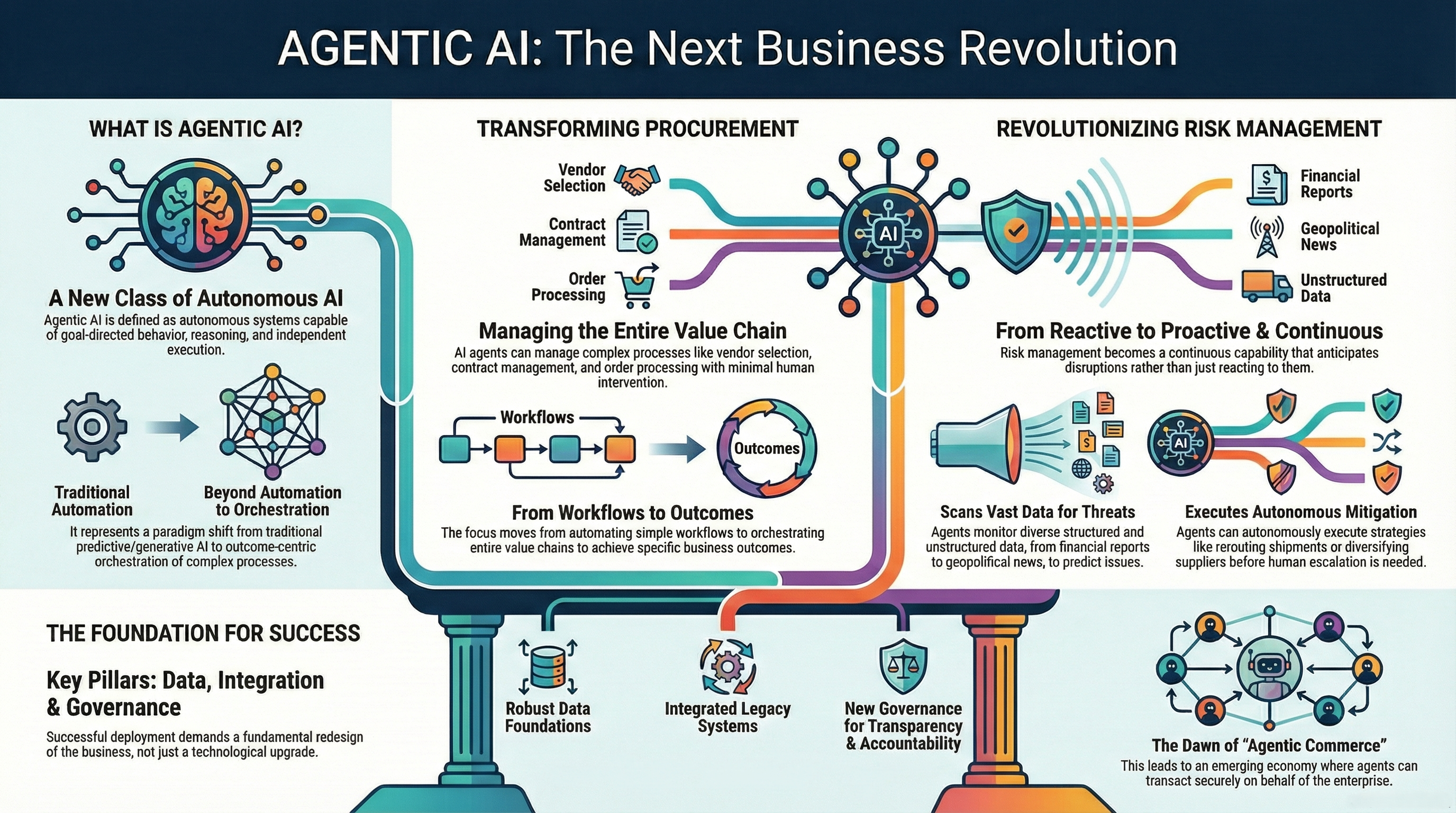
Agentic AI: The New Business Revolution
Procurement is standing at the edge of a structural shift that goes well beyond digitization. For years, teams have added automation, analytics, and AI powered assistants to improve individual tasks. What is emerging now is different in scale and implication. Agentic AI introduces systems that can pursue objectives, make contextual decisions, and coordinate multi step work with limited human prompting. Instead of supporting a person through a workflow, these agents can help orchestrate the workflow itself.
In practical terms, this changes how sourcing events are prepared, how suppliers are monitored, how contracts are managed, and how buying channels are guided. Market intelligence can be gathered continuously rather than periodically. Category strategies can be stress tested against live data. Stakeholder intake can be interpreted and routed with an understanding of policy, risk, and commercial intent. The role of the human professional shifts upward toward judgment, exception handling, and value design.
This evolution raises important questions for procurement leaders. What work should be owned by people, and what should be delegated to autonomous systems. How should governance, controls, and auditability evolve when decisions are partially machine directed. What new skills are required when managing digital agents becomes part of the operating model.
At Caché Procurement, much of the focus is on helping organizations think through these structural questions, not just the technology layer. The opportunity is not simply faster processing. It is a redesign of how procurement creates leverage, insight, and strategic influence in an AI enabled enterprise.
Another dimension often overlooked is organizational design. As AI agents take on repeatable analytical and coordination tasks, traditional role boundaries begin to blur. Category managers, sourcing specialists, analysts, and operations teams may all interact with the same digital workforce. This creates the need for clearer decision rights, new performance metrics, and updated career paths that recognize oversight of AI driven work as a core capability rather than a side responsibility.
If this shift is on your radar, then a deeper discussion is worth your time.